
Join Our Mailing List
Sign up to receive updates on our latest news and events. Your email will never be shared or sold and you can opt out at any time.
No, I don't want to receive updates
Sign up to receive updates on our latest news and events. Your email will never be shared or sold and you can opt out at any time.
No, I don't want to receive updates
An early-stage exploration property in A.I.S. Resources' Lepreau District, in the Grand Bay–Westfield area of southern New Brunswick, underlain by Early Silurian volcanic rocks of the Kingston Group, where A.I.S. field mapping has identified copper-bearing felsic porphyry and associated alteration.
The Grand Bay–Westfield area of southern New Brunswick is underlain mainly by Early Silurian volcanic and volcaniclastic rocks of the Kingston Group.
These include the Bayswater Formation — dacitic to rhyolitic tuffs with felsic porphyry intrusions (GSC).
The area forms part of the Kingston Terrane, which has been interpreted as an Early Silurian volcanic arc based on calc-alkalic volcanic and plutonic rocks and U-Pb zircon ages of approximately 442 ± 6 Ma from dacitic tuff and 437 ± 10 Ma from a granitic pluton (Barr et al., 2002).
Local Stonehammer Geopark descriptions also note that the Brundage Point–Kingston Peninsula area is dominated by Silurian volcanic rocks about 435 Ma, with the Saint John and Kennebecasis river valleys influenced by regional bedrock structure (Stonehammer Geopark, 2022).
Based on this geological setting, the Grand Bay area is considered prospective for volcanic-hosted base-metal mineralization, structurally controlled copper-silver-gold veins, and localized intrusion-related copper-molybdenum-gold porphyry systems.
These exploration concepts require confirmation through systematic mapping, prospecting, geochemical sampling, and geophysical surveys.
Within the Early Silurian volcanic / volcaniclastic rocks of the Kingston Group.
Interpreted to be controlled by regional bedrock structure.
Localized systems associated with felsic porphyry intrusions.
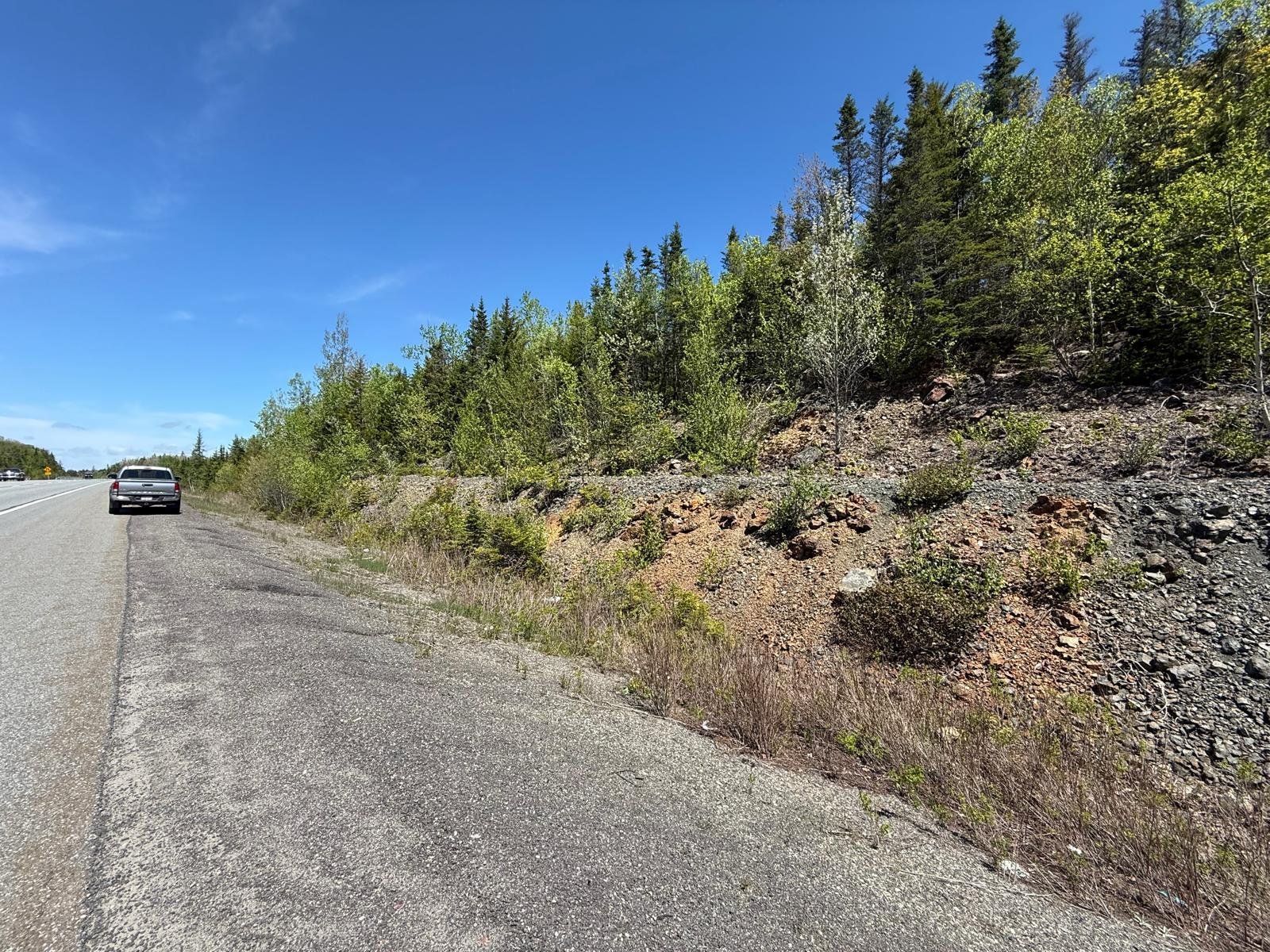
A.I.S. field mapping work revealed the presence of copper-bearing felsic porphyry and pervasive alteration along the porphyry contact.
Quartz + feldspar porphyry in a K-feldspar, hematite-dusted matrix; chalcopyrite in the matrix, replacing feldspar phenocrysts and along micro-fractures.
Pervasive “green rock alteration” within a clastic sedimentary unit; disseminated sulphides along micro-fractures; porphyry-style B-veins present.
Outcrop and hand-sample photography from the Grand Bay property. Photos: Marc Enright-Morin.
Investor Updates
Receive the latest news releases and corporate updates from AIS Resources Ltd. directly to your inbox.
We respect your privacy. Unsubscribe at any time.